Blog
The Post-Merger Watson LIMS™ Problem: A Cost-Effective Path to Decommissioning
A CFO/CIO guide to decommissioning legacy bioanalytical LIMS without compliance risk. Post-merger application rationalization moves quickly until it hits a GxP-regulated system. Both sides of a pharmaceutical M&A often run Watson™ LIMS, and neither environment appears safe to decommission without creating a compliance gap. As a result, both remain on the IT estate, consuming budget year after year, while producing no scientific output. This guide challenges that assumption and shows how to resolve it cost-effectively.

Executive Summary
If your organization has emerged from an M&A deal with more than one Thermo Watson LIMS™ environment in its portfolio, you face a familiar impasse: neither can be simply switched off. The studies they contain are subject to GxP data-retention requirements of 15 years or more, and your scientific teams — reasonably — want data access guaranteed.
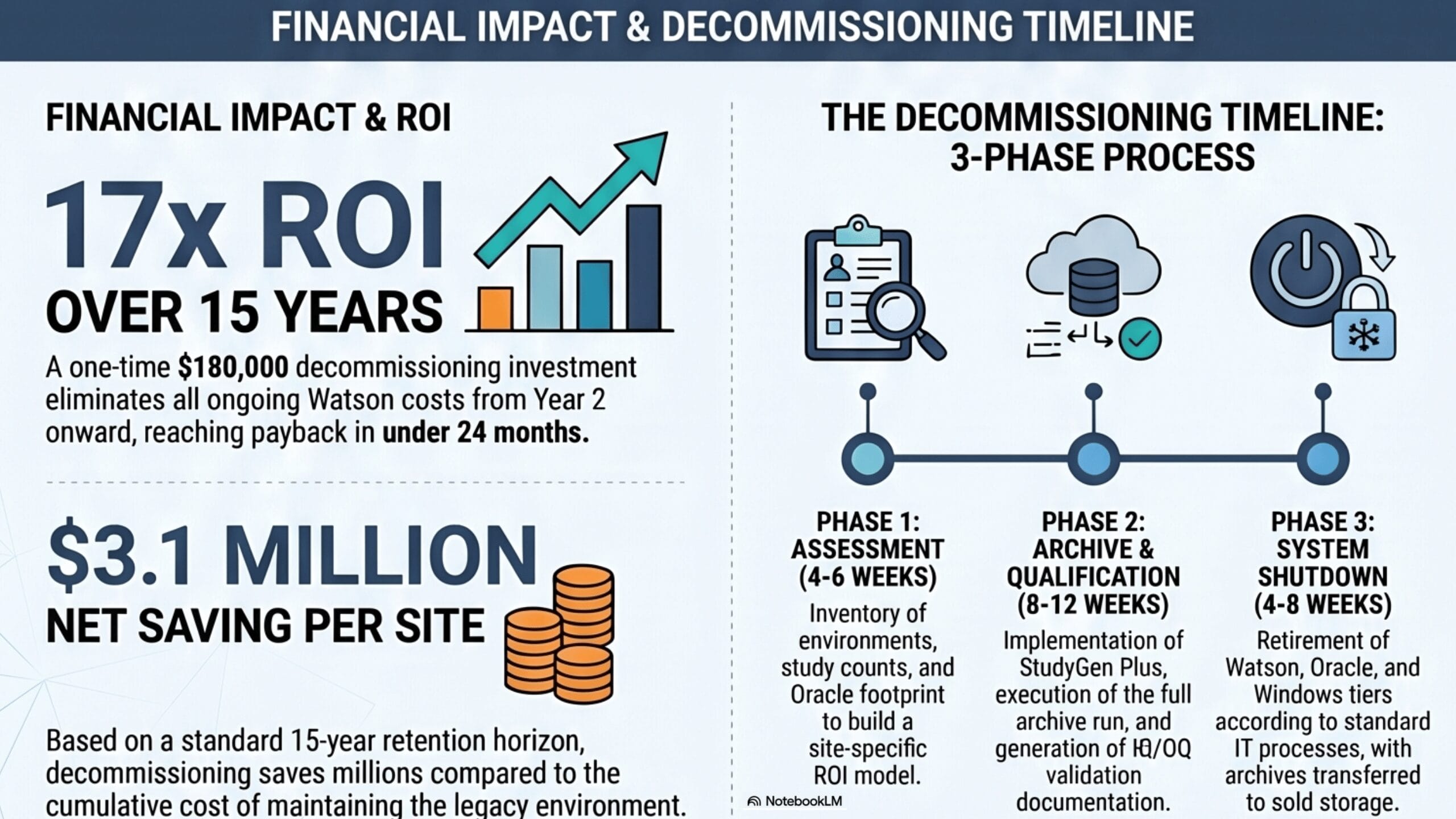
Keeping Watson™ running is not the only way to satisfy that requirement — but it is typically the most expensive approach. The annual cost of a single legacy Watson™ environment runs to approximately $150,000–$160,000 per site, a figure that compounds as Oracle support escalates and platform end-of-life events approach. A one-time decommissioning investment that pays for itself inside Year 2 converts every completed study into a regulator-ready, vendor-independent archive and eliminates all ongoing Watson™ costs from Year 2 onward. Payback comes inside Year 2. Over a standard 15-year retention horizon, the net saving is approximately $3 million per site — roughly 17× the initial investment.
Why Watson™ Is Still Running
Legacy Watson™ environments in post-merger companies share one defining characteristic: they are running, but producing nothing. No new studies are being entered. No configuration changes are being made. The system is, in practice, frozen.
The only remaining use case is occasional data retrieval: a response to an FDA inspection query, a sponsor request, or an internal audit. That requirement is legitimate, but assuming the Watson™ application must remain live to fulfill it is where the financial analysis breaks down.
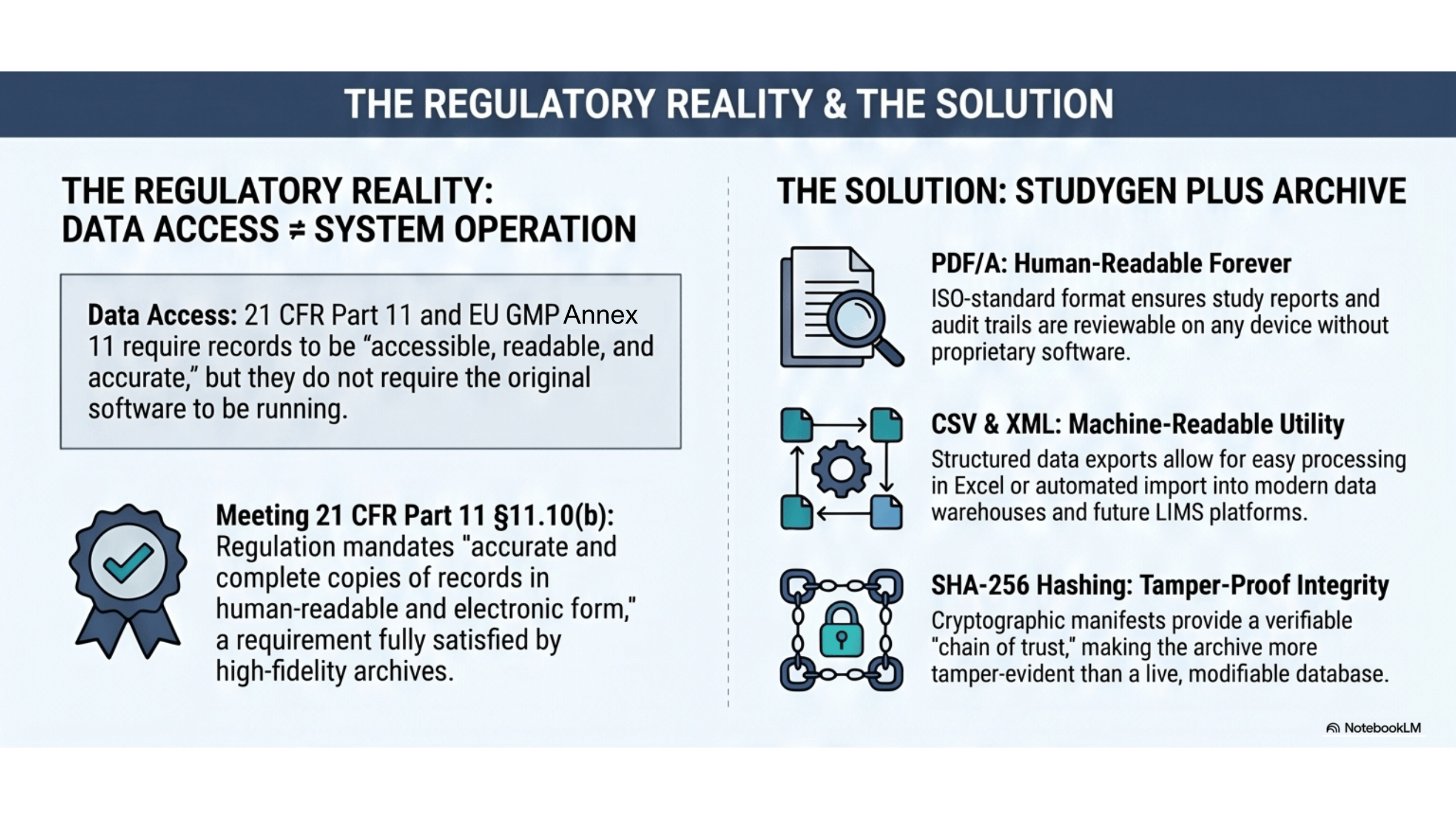
| FDA 21 CFR Part 11 and EU GMP Annex 11, Section 7, require that records remain human-readable, accurate, and complete throughout the retention period. Neither regulation specifies the originating system. Neither requires Watson™ to be operational. |
|---|
A validated archive of PDF/A documents, structured CSV and XML datasets, and cryptographic integrity verification fully satisfies both standards, with no Watson™ component running.
What You’re Really Paying For
The cost of keeping a legacy Watson™ environment running is spread across several budget lines, none of which contribute to active research or scientific output.
| Cost Item | ~USD / Year / Site |
| Watson™ maintenance & support | ~$50,000 |
| Oracle EE support (escalating ~8%/yr) | ~$20,000 — rising |
| GxP IT FTE (0.25 FTE, specialized) | ~$38,000 |
| Periodic revalidation & change control | ~$15,000 |
| DR/hosting/backup | ~$12,000 |
| Windows Server licensing / ESU | ~$6,000 |
| Total per site | ~$150,000–$160,000 |
Four Factors Driving Costs Higher Each Year
Oracle™ Database Support Escalation
Watson™ requires Oracle Database Enterprise Edition™, priced at approximately $47,500 per processor, with annual support at 22% of the net license. Oracle™ increases support fees by approximately 8% per year, with no cap and no negotiated exit.
Windows Server 2016 End of Support, January 2027
Microsoft Extended Support for Windows Server 2016 ends in January 2027, after which premium ESU costs double annually. Migrating to a newer Windows version requires a full GxP revalidation of the Watson™ stack, a costly and time-consuming process for a system that is no longer producing data.
Scarcity of GxP IT Skills
Maintaining a validated GxP system on Oracle™, managing IQ/OQ revalidation cycles, and handling formal change control requires a specialized and increasingly scarce skill set. Allocating a quarter of one FTE to an idle system is a disproportionate cost for a resource your IT organization needs elsewhere.
Revalidation Obligation Regardless of Activity
Under GxP regulations, any change to the underlying platform, whether a security patch, a hardware refresh, or an OS update, triggers a revalidation obligation regardless of whether the system is in active use. A frozen, idle system on aging infrastructure demands the same level of compliance discipline as a fully productive one.
The Archive Format: Compliant, Independent, Permanent
The StudyReporter Archiving Module generates three types of output for every completed Watson™ study:
- PDF/A documents: an ISO-standard long-term archival format, readable on any device, without proprietary software, permanently.
- CSV and XML datasets: all analytical results, calibrations, samples, regressions, and audit trails in structured, machine-readable form, compatible with any data warehouse or future LIMS platform.
- Cryptographic integrity verification: a SHA-256 hash for every output file, plus a combined hash of all files logged in the processing protocol. Any modification to any archived file after the fact is immediately and provably detectable.
A signed, hash-verified flat-file archive simplifies the complex compliance perimeter of a live database down to secure files. The archive requires no Watson™ license, no Oracle™ license, and no proprietary viewer software, now or in the future.
Validated in Production
Boehringer Ingelheim, one of the world’s largest pharmaceutical companies, completed this transition using the StudyReporter Archiving Module. Their scientific and quality teams had the same concerns about data accessibility after decommissioning. Every study remains fully accessible, audit-ready, and compliant. Watson™ is gone. A leading Japanese top-20 pharmaceutical company has independently completed the same transition.ting the ongoing infrastructure obligation entirely.
The Business Case
The following figures are based on the up to data ROI model, available in full on request. All numbers are conservative estimates based on publicly available pricing models.
| Criteria | Per Site |
| One-time investment | ~$180,000 |
| Annual savings from Year 2 | ~$155,000/yr |
| Payback period | ~2 years |
| Net saving — 10 years | ~$1.8M |
| Net saving — 15 years (retention horizon) | ~$3.1M |
| ROI multiple (15-yr horizon) | ~17x |
The one-time investment covers licensing, implementation, validation documentation (IQ/OQ), and a complete archive run across all completed studies. There is no annual support fee, no subscription, and no ongoing vendor relationship. Once the archive run is complete, the StudyReporter Archiving Module is retired alongside Watson™, leaving no ongoing application-vendor dependencies.
Model assumptions are based on the following publicly available inputs: Oracle™ Database EE list price of $47,500 per processor (Oracle™ Technology Price List, 2026), annual support at 22% of the net license, and a support escalation rate of approximately 8% per year. Watson™ licensing figures rely on conservative industry estimates; actual contracted rates should be used during qualification. GxP IT FTE is modeled at 0.25 FTE at $150,000 fully loaded annual cost, adjusted to local market rates. Windows Server ESU pricing follows Microsoft’s published schedule, doubling annually after January 2027.
A detailed Excel model with configurable inputs for all cost assumptions is available on request from up to data GmbH.
What a Structured Exit Looks Like
A Watson™ decommissioning project runs in three phases, with a total elapsed time of 4 to 6 months from project start to system shutdown.
| Phase | Activity | Duration |
| Assessment | Inventory of Watson™ environments, study counts, Oracle™ footprint, and integration dependencies. Output: decommissioning scope document and a site-specific ROI model. | 4-6 weeks |
| Archive and Qualification | StudyReporter Archiving Module configured, IQ/OQ validation documentation prepared, full archive run executed across all completed studies, integrity verification completed and documented. Output: validated study archive and QA sign-off package. | 8-12 weeks |
| Decommissioning | Watson™, Oracle™, and Windows tiers retired following your standard IT decommissioning process. Archive transferred to cold storage. Ongoing application maintenance cost: effectively zero. | 4-8 weeks |
Conclusion: The Decision That Pays for Itself
The economic case for decommissioning Watson™ does not require optimistic assumptions. It requires only an honest comparison between what the system currently costs, in Oracle™ support, Windows infrastructure, specialist IT staff, and revalidation overhead, and a one-time investment that permanently removes all of those costs.
While compliance fears keep legacy systems running, they often rest on a misinterpretation of regulatory text. You do not need to be mid-integration to act. An organization that has carried an inherited Watson™ environment for three or five years faces the same escalating cost drivers. Past costs cannot be recovered, but future costs are entirely avoidable.
Request a Decommissioning Assessment
Contact us at info@uptodata.com to schedule a structured 30-minute environment review. We will produce a tailored cost-of-inaction analysis for your integration review board. You can download our companion document — Decommissioning Watson™: Answers to the Questions Your QA and Lab Directors Will Ask — to help IT and finance leaders in addressing the scientific and compliance concerns that typically arise when decommissioning is first proposed.
References
European Commission (2011). EU guidelines for good manufacturing practice for medicinal products for human and veterinary use: Annex 11, computerized systems. EC EudraLex Volume 4.
European Medicines Agency & Pharmaceutical Inspection Co-operation Scheme (2025). Joint stakeholders consultation on the revision of Chapter 4 on Documentation, Annex 11 on Computerized Systems, and on the new Annex 22 on Artificial Intelligence of the PIC/S and EU GMP Guides. PIC/S News.
U.S. Food and Drug Administration (2026). 21 CFR Part 11 (Electronic Records; Electronic Signatures) and 21 CFR Part 58.195 (Good Laboratory Practice for Nonclinical Laboratory Studies — Record Retention).
up to data has been supporting pharmaceutical and life sciences companies with automated laboratory data management for over 20 years. Our solutions eliminate data silos, implement secure automated data transfer processes, and reduce manual activities while ensuring full regulatory compliance. The StudyReporter Archiving Module is a production-proven solution, validated and in use at leading global pharmaceutical companies, including Boehringer Ingelheim and a leading Japanese pharmaceutical company.
This content might also be engaging for you!
-
The Invisible Compliance Abyss: The Bioanalytical Data Integrity Risk in Every Spreadsheet—and How StudyLab Restores Complete Control
Blog The Invisible Compliance Abyss: The Bioanalytical Data Integrity Risk in Every Spreadsheet—and How StudyLab Restores Complete Control In…
-
Stop the Copy–Paste–Verify–Repeat Loop in GxP Bioanalytical Reporting
Blog Stop the Copy–Paste–Verify–Repeat Loop in GxP Bioanalytical Reporting Every regulated report begins the same way: you gather the…
-
Mitigating the Risks of Non-Digital Study Reporting: What Bioanalytical Labs Need to Know
Blog Mitigating the Risks of Non-Digital Study Reporting: What Bioanalytical Labs Need to Know In a regulated bioanalytical lab,…