Blog
Long-term Study Archiving After Watson LIMS™: Key Insights for Regulated Bioanalytical Labs
In a regulated bioanalytical lab, the work doesn’t end when a study is finalized — the data has to stay complete, retrievable, and compliant for many years to come. A recent up to data Expert Coffee Break brought together CEO Norbert Bittner and bioanalytical lab expert Monica Terrao, PhD, moderated by Magnus Hauman, to unpack what long-term study archiving really means for Watson LIMS™ users — and why it is fundamentally different from a backup.
Understanding the Stakes: Why Archiving Is Not a Backup
The integrity of bioanalytical data underpins every regulatory submission — and that integrity has to survive long after a study closes. When an inspector arrives, they rarely care how you back up your servers. They care whether your data is complete, retrievable, and compliant, and whether a single number in a five-year-old report can be traced back to the raw data within the hours they give you.
That is where the difference between a backup and an archive becomes critical. A backup exists for short-term disaster recovery and is routinely overwritten; an archive is the long-term, immutable store of the final record. Treating one as the other is a common — and costly — mistake. The risks of inadequate archiving are significant and multifaceted:
- Business & Reputational Impact: Delays, holds, and audit findings can compromise sponsor relationships and a CRO’s ability to win new work.
- Inspection & Compliance Risk: If a reported value can’t be traced back to its raw data in time, a finding can escalate to a warning letter, an import alert, or even a clinical hold.
- Data Integrity & Traceability: A broken link among raw data, the audit trail, and the final report results in data that is neither complete nor ALCOA+ compliant under FDA 21 CFR Part 11 and EU Annex 11.
- Legacy-System Cost: Keeping a retired system alive solely to remain compliant entails ongoing licenses, storage, revalidation, and specialist know-how — potentially for a decade or more.
- Technology Obsolescence: Operating systems, databases, and hardware move on. A system architected today may be practically unusable in 15 to 25 years.
- Vendor Lock-In: Proprietary archive formats tie your data to a single vendor that may be acquired, change direction, or disappear.
Video Recording | The Life of Studies After Watson LIMS™
Get the full discussion on long-term study archiving for regulated Watson LIMS™ labs — the regulatory drivers, the hidden cost of keeping legacy systems alive, and how a human-readable, vendor-independent archive keeps study data traceable, defensible, and inspection-ready.
If you have any technical issues watching the video recording, please contact marketing[at]uptodata.com.
Backup, Storage, and Archive: Knowing the Difference
Traditional archiving offers a useful mental model. You have an archivist, a secure room, an index that maps where each file lives, defined retention rules, and an SOP that governs the entire process. The modern challenge is simply transporting that mechanism into the electronic world — while preserving the same discipline.
A backup does not meet that bar. Its purpose is to recover from events such as disasters, accidental loss, or corruption. Its retention is typically short, and most of it is overwritten over time, which is exactly why it was never designed to serve as an archive. An archive, by contrast, is meant for the long-term storage of the final record: an immutable, indexed, identical copy of the original, kept separate and unchangeable. Under a Quality-by-Design approach — and guidelines such as ICH M10 and FDA 21 CFR Part 58 — that archive isn’t optional. It is a regulatory requirement, with retention periods that can extend up to 25 years depending on the study type.
The Hidden Cost of Keeping a Legacy System Alive
Faced with these requirements, many labs default to the seemingly simplest option: just keep the original system running. In practice, that is often the most expensive path of all. Archiving typically becomes relevant precisely when a system is decommissioned — at end of life, or after a merger or acquisition leaves two systems in place — and the driver is almost always cost and risk.
Over a 25-year retention period, infrastructure never stands still. Every change to the CPU, operating system, database, or application version can force a fresh round of validation to prove the data hasn’t changed, and the system still behaves as expected. The webinar illustrated the extreme end of this with a cautionary tale: a lab that preserved two aging MicroVAX computers in a climatic chamber simply to keep old data readable — with little chance of finding anyone who still knows how to operate them. Meanwhile, proprietary chromatography formats from vendors such as SCIEX or Waters remain difficult to standardize, and industry efforts (for example within the EBF) have yet to produce a universal, human-readable format. The result is a growing dependency on systems that are increasingly hard — and expensive — to sustain.
Why a Native Archive Function Often Isn’t Enough
Watson™’s own archive-study function is genuinely useful for exchanging data between locations or systems. As a long-term study archive, however, it has real limitations. The output is a copy of the underlying proprietary Microsoft database schema — roughly nineteen linked tables — that is not human-readable and carries no data integrity or context on its own. To turn it back into meaningful results, you need to understand the data structure, have the right queries, and, crucially, still run Watson™ itself: because the system stores values in full precision, the final rounded concentrations that appear on your reports can only be reproduced inside Watson™.
That dependency defeats the purpose of decommissioning and, from a regulatory perspective, can also compromise traceability. If the link from raw data to result and report is lost, or the audit trail isn’t carried along as part of the record, the archive is no longer ALCOA+ compliant and falls short of 21 CFR Part 11 and EU Annex 11.
Building a Future-Proof, Vendor-Independent Archive
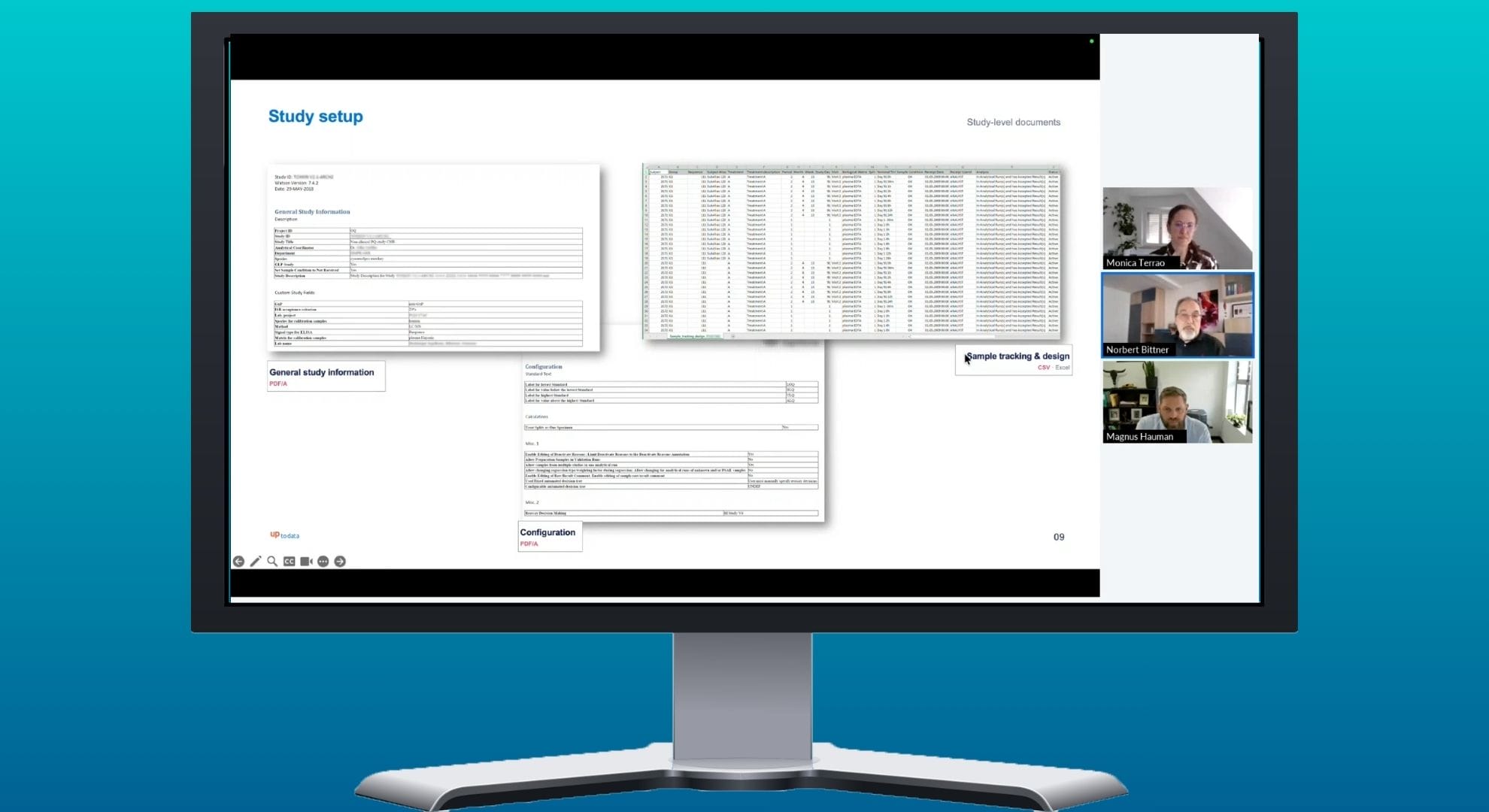
The alternative — developed together with leading bioanalytical laboratories — is to create a human-readable archive that preserves the full scientific context of a study, so that runs, results, samples, and raw data files remain understandable decades from now. Instead of one opaque file, the export is a structured document stack organized by run, combining several open formats:
Every record is provided as an ISO-certified PDF/A for long-term readability, and as CSV and XML for genuine reprocessability, so the data can be re-analyzed with standard tools rather than a single proprietary application. Because these files live on a file system that people could, in principle, alter, integrity is protected cryptographically: each file receives a hash value, all hashes are collected in a hash table, and a hash-of-hashes acts as a double key to prove nothing has changed. The complete audit trail — covering study-, run-, and sample-level events plus system activity during the study — is delivered as a searchable HTML file with full-text and column filtering. And because the whole process runs in parallel with normal lab operations, archiving adds no extra work and causes no delays in data delivery.
Implementation and Validation
Bringing this into a lab follows a structured, roughly 12-week path: the first weeks focus on requirements gathering, followed by an iterative build-and-configuration phase, with user acceptance testing and training in the final stretch — all delivered hand in hand to match what was scoped at the outset.
The decisive advantage is that this is a one-time activity. Rather than revalidating a live system every time hardware or software changes, you validate the transfer once, confirm the archive, and store it. Working in line with GAMP 5 and a risk-based Computer Software Assurance mindset, up to data provides the qualification documentation (IQ, OQ, PQ) that labs can leverage — while the lab retains ownership of the validation and decides, via its own risk assessment, how deep it needs to go. Once the validated archive exists, both the archiving tool and the original Watson™ system can be switched off, leaving only the immutable archive to maintain.
Conclusion
The clearest takeaway from the discussion is to design for decommissioning from day one. Establishing archiving as part of a Quality-by-Design approach — with open, transportable, human-readable formats and no vendor lock-in — means a lab is audit-ready for the entire retention period without carrying the cost and risk of an aging system. Data stays defensible, traceable, and compliant; and once it has been archived and the archive validated, the legacy environment can finally be retired. For labs starting a new system today, the advice is equally direct: talk to your sponsors, follow the guidelines, and, wherever vendors don’t yet offer proper archiving, push them to move in that direction.
This article is based on insights from an Expert Coffee Break webinar presented by Norbert Bittner, CEO of up to data, and Monica Terrao, PhD, bioanalytical lab expert, moderated by Magnus Hauman. up to data specializes in digitized, automated laboratory processes and the long-term, compliant management of regulatory study data.
This content might also be engaging for you!
-
The Invisible Compliance Abyss: The Bioanalytical Data Integrity Risk in Every Spreadsheet—and How StudyLab Restores Complete Control
Blog The Invisible Compliance Abyss: The Bioanalytical Data Integrity Risk in Every Spreadsheet—and How StudyLab Restores Complete Control In…
-
Stop the Copy–Paste–Verify–Repeat Loop in GxP Bioanalytical Reporting
Blog Stop the Copy–Paste–Verify–Repeat Loop in GxP Bioanalytical Reporting Every regulated report begins the same way: you gather the…
-
Mitigating the Risks of Non-Digital Study Reporting: What Bioanalytical Labs Need to Know
Blog Mitigating the Risks of Non-Digital Study Reporting: What Bioanalytical Labs Need to Know In a regulated bioanalytical lab,…