Blog
Mitigating the Risks of Non-Digital Study Reporting: What Bioanalytical Labs Need to Know
In a regulated bioanalytical lab, a study report is only as trustworthy as the process behind it. Yet many CRO–sponsor partnerships still assemble their reports by hand — moving data across spreadsheets, Word templates, and, in the worst case, paper. In a recent up to data webinar, “Mitigating Risks of Non-Digital Study Reporting Processes,” Managing Director Norbert Bittner walked through the full journey of study data and showed exactly where non-digital study reporting introduces risk — and what regulators now expect labs to do about it.
Understanding the Stakes
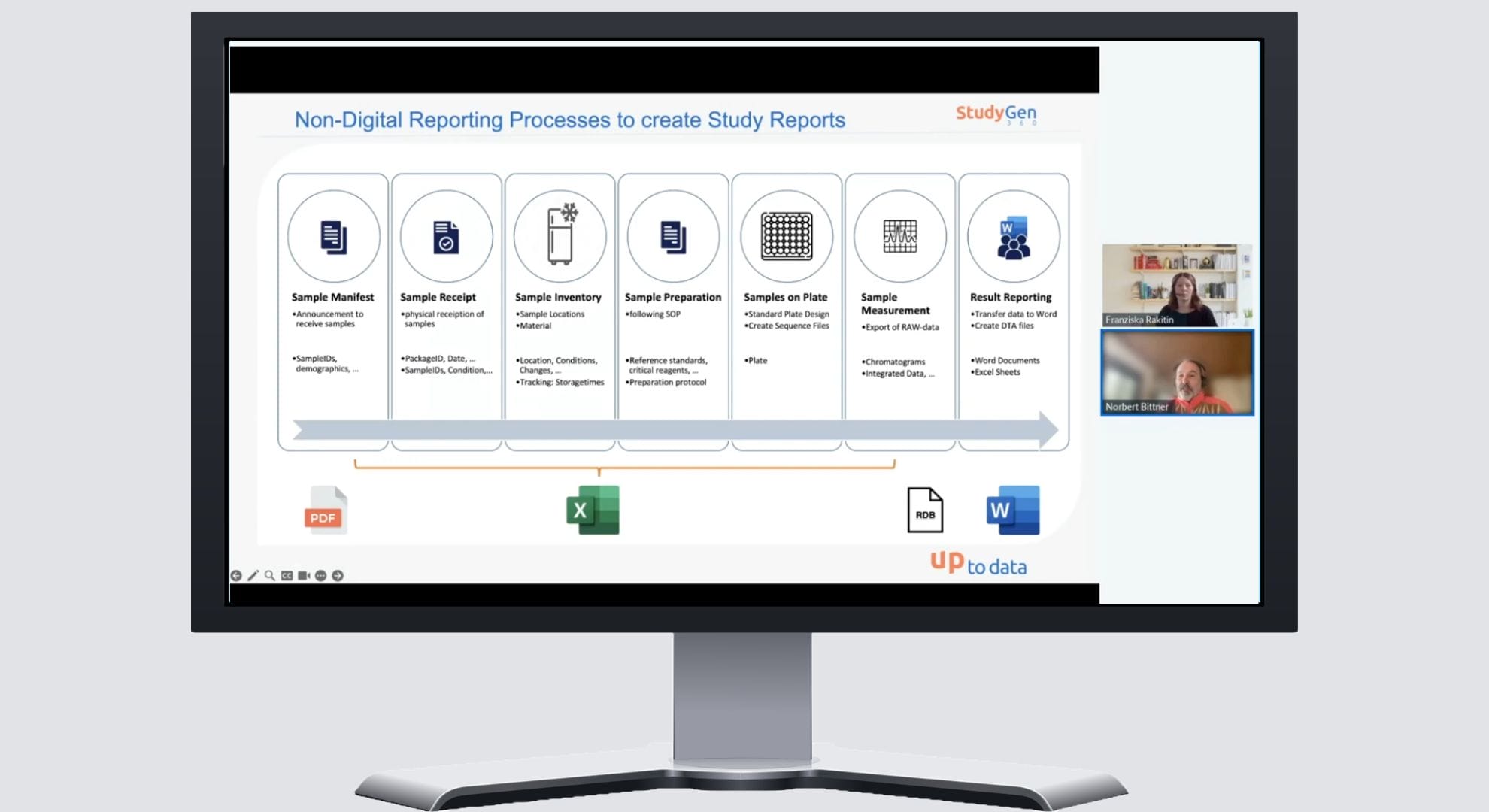
Reporting is not a single step at the end of a study — it is the last link in a long chain that starts the moment samples are announced. A sample manifest arrives, usually as a PDF. Samples are received and logged. Inventory records are now being created, including the materials and reference standards the agencies expect you to document. Samples are prepared, standards and QCs are built following SOPs, plates are designed, and instruments generate raw data. Every one of those steps creates records — and when they live in disconnected spreadsheets, those records have to be copied, merged, and re-tabulated by hand to produce the final report and the data transfer package for the sponsor.
That manual assembly is where the risks accumulate:
- No closed system and no guaranteed data integrity — even a “validated” Excel sheet offers no assurance that the original data is protected from change.
- Calculation pitfalls — rounding and decimal handling in Excel are notoriously error-prone, and comprehensive evaluation across runs is difficult.
- Transcription and transfer errors — every manual hand-off between sheets, templates, and the data transfer file is an opportunity for mistakes.
- No instant reporting — someone has to sit down and compile information into new documents every time.
- Sponsor template variability — differing requirements from each sponsor add complexity to an already fragile process.
Video Recording | Mitigating Risks of Non-Digital Study Reporting Processes
Get the full discussion — to watch the recording, please accept marketing cookies via the Borlabs consent banner. External content from YouTube will only be loaded once you have given your consent.
If you have any technical issues watching the video recording, please contact marketing[at]uptodata.com.
What Regulators Now Expect
The regulatory bar has risen. ICH M10 (“Bioanalytical Method Validation and Study Sample Analysis”) now sets out explicit expectations for which records must be kept and what belongs in the report itself — from handling the blank matrix to including a copy of the certificate of analysis for a reference standard. These records are now explicitly part of a GxP-relevant regulatory document, and they must be handled in a 21 CFR–compliant manner, whether on paper or electronically.
For a broader view of current thinking on data integrity, the webinar points to the WHO guideline on data integrity (Annex 4 of WHO Technical Report Series No. 1033). It is a compact, comprehensive document that consolidates much of what the European and American agencies increasingly refer to — and the consistent message is to reduce risk through technical rather than purely procedural controls, built on a risk-based data governance approach embedded in your quality system.
From Stop-Gap to Purpose-Built
If a full laboratory system isn’t on the table yet, there are interim ways to add control. Many labs already have Microsoft SharePoint through Microsoft 365, which provides document management with access controls, version control, and a version history that functions like a basic audit trail. It is a genuine step forward — but it comes with a catch: as a SaaS environment, it still has to be qualified, and you take on responsibilities for backup, availability, and long-term storage.
A purpose-built, fully qualified solution removes that burden. up to data’s StudyGen 360 was designed to create the final, ICH M10–compliant report directly from your raw data. To keep the system closed and protect data integrity, it works from the original raw data files rather than editable CSVs, extracts the results into the report, and captures the surrounding documentation — sample preparation, reference standards, and critical reagents. It rolls out with minimal effort and dramatically reduces the time needed to produce a report. Beyond report creation, the platform extends to the broader bioanalytical process — managing lab sample metadata, document life cycles, version control, and GLP-compliant data integrity, with direct interfacing with laboratory instruments.
Conclusion
The advice from the webinar is refreshingly direct: get rid of the manual way. Non-digital study reporting is slow, error-prone and increasingly hard to defend against regulatory expectations. Whether you bridge the gap with tools you already own or move to a purpose-built platform, the goal is the same — a closed, auditable process that protects data integrity and gives your team back the time they spend copying, pasting and verifying. Watch the recording above for the full walkthrough, then talk to us about where your own reporting process could be made more robust.
This article accompanies the up to data webinar “Mitigating Risks of Non-Digital Study Reporting Processes.” Presented by Norbert Bittner, Managing Director at up to data; moderated by Franziska Rakitin.
This content might also be engaging for you!
-
The Invisible Compliance Abyss: The Bioanalytical Data Integrity Risk in Every Spreadsheet—and How StudyLab Restores Complete Control
Blog The Invisible Compliance Abyss: The Bioanalytical Data Integrity Risk in Every Spreadsheet—and How StudyLab Restores Complete Control In…
-
Stop the Copy–Paste–Verify–Repeat Loop in GxP Bioanalytical Reporting
Blog Stop the Copy–Paste–Verify–Repeat Loop in GxP Bioanalytical Reporting Every regulated report begins the same way: you gather the…
-
Long-term Study Archiving After Watson LIMS™: Key Insights for Regulated Bioanalytical Labs
Blog Long-term Study Archiving After Watson LIMS™: Key Insights for Regulated Bioanalytical Labs In a regulated bioanalytical lab, the…