Blog
Stop the Copy–Paste–Verify–Repeat Loop in GxP Bioanalytical Reporting
Every regulated report begins the same way: you gather the data, enter it into a spreadsheet, transfer it to a document, verify it, and have someone else verify it again. Whenever there’s a change, this cycle repeats. In the second episode of our Expert Coffee Break series, CEO Norbert Bittner and bioanalytical lab expert Monica Terrao, PhD, are moderated by Magnus Hauman. They examine why this cycle—rather than the writing itself—accounts for most bioanalytical reporting time and how it subtly affects your data integrity.
Understanding the Stakes:
The conversation highlights that the report is only a small part of the overall picture. Most of the cost and risk lie in the manual, uncontrolled processes surrounding it. If these are not managed, it leads to:
- Study data is dispersed across instruments, servers, and USB exports, making it impossible for any SOP to fully control it.
- A broken ALCOA/data integrity chain occurs when binary instrument data is exported to Excel or CSV without version control.
- QC review cycles may extend to four weeks, with sponsor reviews sometimes lasting several months.
- Repeating validation each time numbers are transferred from Excel to Word.
- A delayed time-to-market for a blockbuster product can result in significant profit loss.
- Inspection preparation that consistently distracts scientists from producing results.
- AI “help” that hallucinates or silently accesses the audit trail it should not access.
Video Recording | Stop — COPY | PASTE | VERIFY | REPEAT — in GxP Bioanalytical Reporting
Get the complete discussion on GxP bioanalytical reporting, including the often-overlooked, time-consuming areas such as data capture, QC review, and authoring. Learn why achieving “faster” and “more compliant” results isn’t a trade-off, and how a validated, automated reporting system ensures that study data remains traceable, defensible, and inspection-ready.
If you have any technical issues watching the video recording, please contact marketing[at]uptodata.com.
Where the Reporting Time Really Goes
The report-writing process centers on four key time-saving dimensions: data capture, QC review, authoring, and inspection preparation. The first step occurs before a single sentence is written—data collection. In a typical lab, data is dispersed among multiple analysts and instruments. Some have direct, reliable server connections, while others transmit results via USB sticks with filenames assigned by the instrument software. Despite strict SOPs and naming conventions, consistent adherence requires heavy reliance on human control. As noted in the Expert Coffee Break, this control cannot be fully trusted in an open system where anyone can make changes.
The main concern revolves around the security of the data. Exporting data from a validated binary format to Excel or CSV without proper version control can threaten its integrity. Every time the file is accessed afterward, it must be verified to match the original measurement exactly. Since data is received intermittently during a study, continuous integrity checks are necessary, not just at the end.
When “Automation” Isn’t Really Automation
This is also where the question often arises: should we validate our Excel sheets? The pragmatic view is that validation holds little value if both input and output are uncontrolled. Using Excel as an intermediate step doubles the quality control effort—you must verify the data when it enters the sheet and again when it is transferred to the report. The same applies to templates. While a report template provides a helpful structure for the author, it does not improve data integrity or reduce total time spent.
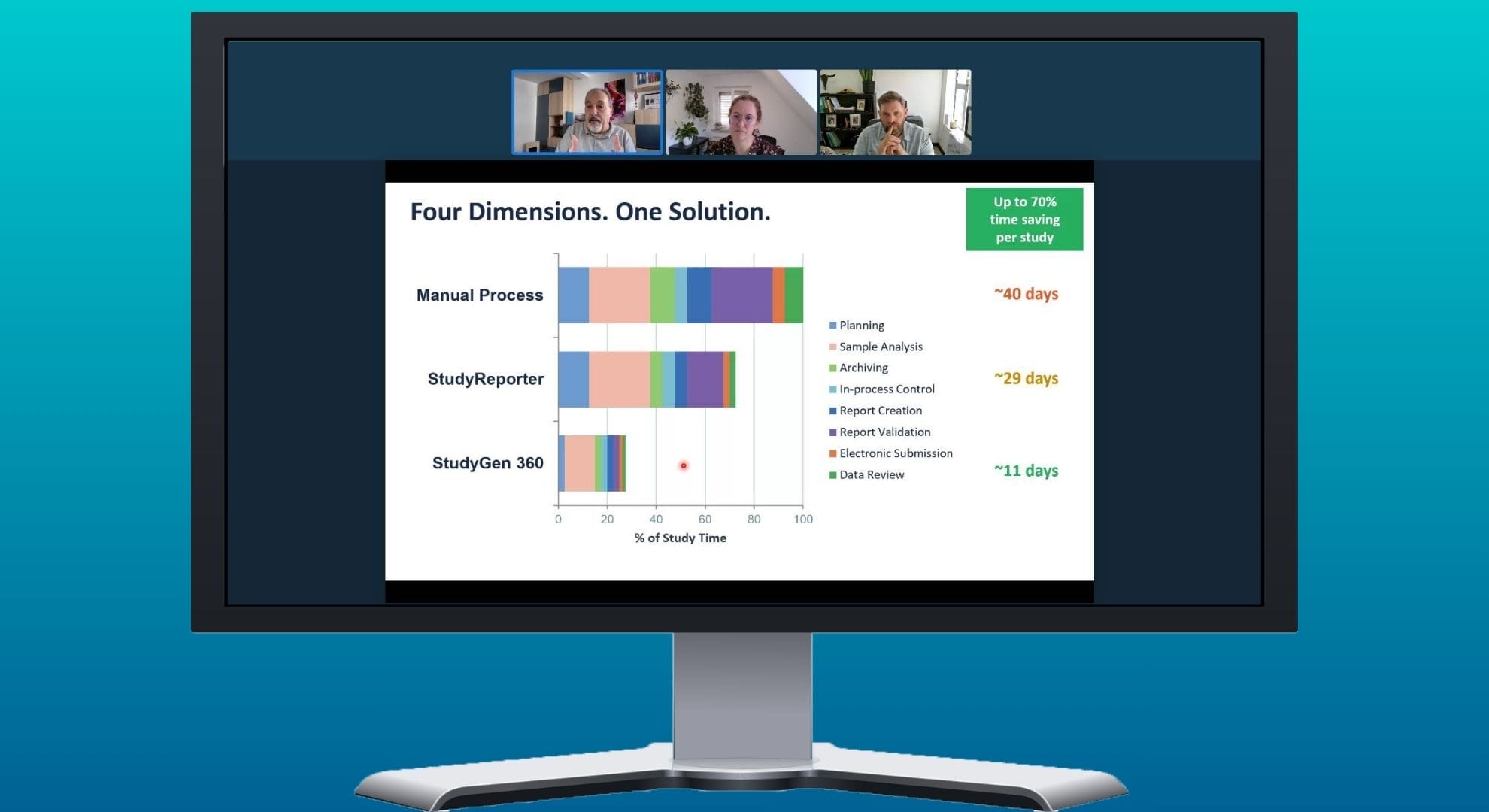
Real automation converts scattered instrument and LIMS data into compliant reports that are ready for submission by extracting validated data and assembling the report within a secure system. According to the speakers, this process can save up to 70% of reporting time, based on a customer measurement comparing the hours spent before and after the project across more than twenty reporting steps. In the example provided, the review-and-correct cycle was nearly eliminated. This reduction in reporting time can shorten the overall study timeline by approximately 25%, even before considering other early-stage efficiencies.
What Saved Time Is Worth to a Sponsor
For a sponsor, time saved isn’t usually about reducing study fees but about preventing lost profit due to delays. The speakers emphasized this point: a blockbuster product can generate around a billion euros in profit each month, so a four-week reporting delay affects market opportunity and patent timing more than a few thousand euros in study costs. A CRO or lab that provides compliant results promptly, allowing the sponsor to review data as it’s generated rather than all at once at the end, is the one that secures the next contract.
Inspection Readiness as a Competitive Edge
The final aspect is being naturally inspection-ready. When documentation is disorganized, teams waste days or even weeks preparing for inspections, diverting focus from results. A lab that stays inspection-ready at all times can instead dedicate that time to work, remain compliant more quickly, and become a more appealing partner for sponsors. Importantly, “faster” and “more compliant” are not mutually exclusive: a controlled system automatically preserves the audit trail and data lineage—eliminating the need for manual SOP procedures—thereby achieving speed without compromising compliance, built on the same reliable foundation.
One Platform on Top of What You Already Have
This is the thinking behind StudyGen 360. It is deliberately not a LIMS, not an SDMS, and not a general-purpose archive that simply stores raw data. It is a study data management system that sits on top of the systems you already have — extracting and organizing data, running analyses at the end of each run, compiling interim and final reports, and producing archive-ready output at the push of a button. Because it is a cloud solution, you can give a sponsor restricted, real-time access to their study alone, so review happens continuously rather than in one anxious pass at the end. Built-in quality checks go far beyond ICH M10 — not just the usual QC and calibration checks, but analyses of how runs and plates behave over time, watching for drift or shift in LBA and LC-MS workflows.
Conclusion: Using AI in a GxP Lab Without Breaking It
When discussing AI’s realistic role in a GxP lab today, both speakers candidly acknowledge the current landscape. The hype centers on LLMs—such as ChatGPT and Copilot—whose so-called “creativity” often results in hallucinations. These systems are inherently non-deterministic and are frequently updated by providers, so their outputs can vary daily. The guidance cited by the speakers is from ISPE’s work on AI risk assessment, which highlights that a human must remain involved at every GxP-related step. AI should be viewed as a new coworker—useful for drafting and summarization but always requiring verification. Its output should never be added directly to the audit trail or treated as an unverified data source. Their main message is to digitize first, then use AI assistance. A validated, automated data foundation is crucial; building AI on a disorganized system yields untraceable results. In StudyGen 360, they employ a “context-first AI” approach that enables analysis of your data without transmitting it to the AI.
This recording is part of the up to data Expert Coffee Break series. Featuring Norbert Bittner (CEO & Founder, up to data), Monica Terrao, PhD (Bioanalytical SME), and Magnus Hauman (moderator).
This content might also be engaging for you!
-
The Invisible Compliance Abyss: The Bioanalytical Data Integrity Risk in Every Spreadsheet—and How StudyLab Restores Complete Control
Blog The Invisible Compliance Abyss: The Bioanalytical Data Integrity Risk in Every Spreadsheet—and How StudyLab Restores Complete Control In…
-
Mitigating the Risks of Non-Digital Study Reporting: What Bioanalytical Labs Need to Know
Blog Mitigating the Risks of Non-Digital Study Reporting: What Bioanalytical Labs Need to Know In a regulated bioanalytical lab,…
-
Long-term Study Archiving After Watson LIMS™: Key Insights for Regulated Bioanalytical Labs
Blog Long-term Study Archiving After Watson LIMS™: Key Insights for Regulated Bioanalytical Labs In a regulated bioanalytical lab, the…