Blog
One Study. Multiple Systems. Countless Copies: Why an Analytical LIMS Does Not Solve Data Integrity in Bioanalysis
A bioanalytical study does not begin when the first sample is logged into a system. It begins weeks earlier — with a shipment manifest, a storage plan, and booked instruments. And it does not end when the last result is generated. It ends with a signed report that must withstand every question an auditor may ask.
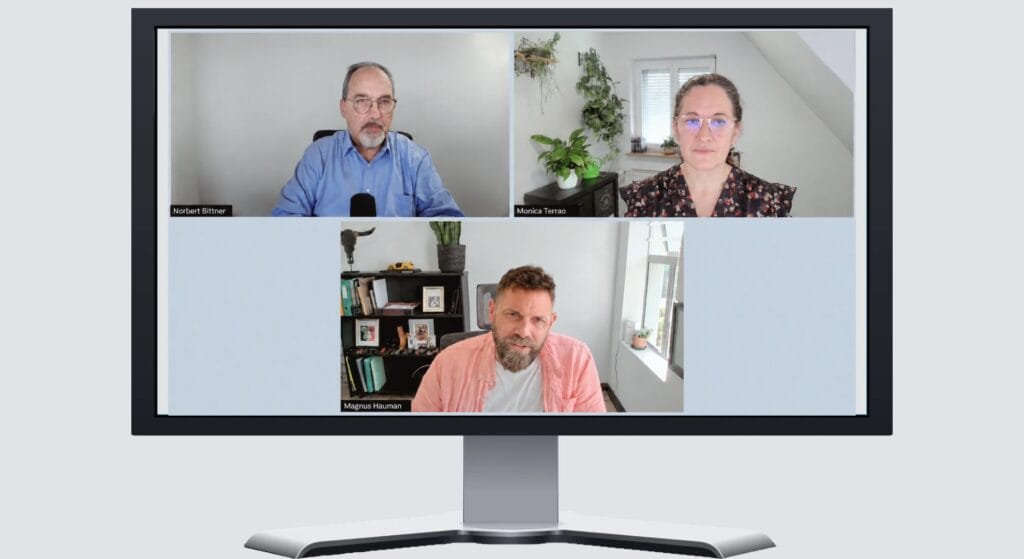
In the third and final episode of our 2026 Expert Coffee Break series, CEO Norbert Bittner and bioanalytical expert Monica Terrao, PhD, moderated by Magnus Hauman, follow one bioanalytical sample from planning to the signed report. Their conclusion is clear: an analytical LIMS is designed around individual samples, while bioanalysis is designed around studies. The greatest risk to data integrity therefore lies not in the systems themselves, but in the gaps between them.
Understanding the Stakes: Why Bioanalysis Needs More Than a Sample-Centered LIMS
Analytical LIMS platforms are excellent at managing samples, tests, and results. Bioanalytical studies, however, are complex, longitudinal, and sponsor-specific. They involve expected sample lists, protocol amendments, shipments, demographics, storage conditions, aliquots, reagents, QC samples, and reporting requirements.
Everything a LIMS does not cover ends up somewhere else — usually in Excel, email, paper forms, or local spreadsheets. If you don’t control those gaps, they create fragmented data, manual rework, and audit risk.
Typical examples include:
- Study plans, expected samples, and protocol changes living in email threads and spreadsheets rather than in a controlled system.
- Standard LIMS treating longitudinal samples as isolated data points, failing to natively link 1,500 samples over a two-year timeline to 100 subjects and clinical profiles.
- Sample demographics stored in a separate Excel file and connected to the LIMS only through a sample ID.
- Freeze-thaw cycles and aliquots tracked on a sheet attached to the freezer, putting result validity at risk.
- Sample preparation, reagent use, and QC samples missing from the LIMS, making it difficult to trace a faulty reagent to affected samples.
- Titer and cut-point evaluations performed in Excel, adding copy-and-paste steps that undermine the ALCOA principles.
- Days of manual rework when a central laboratory reports that five samples were assigned to the wrong subject.
Video Recording | One Study. Multiple Systems. Countless Copies.
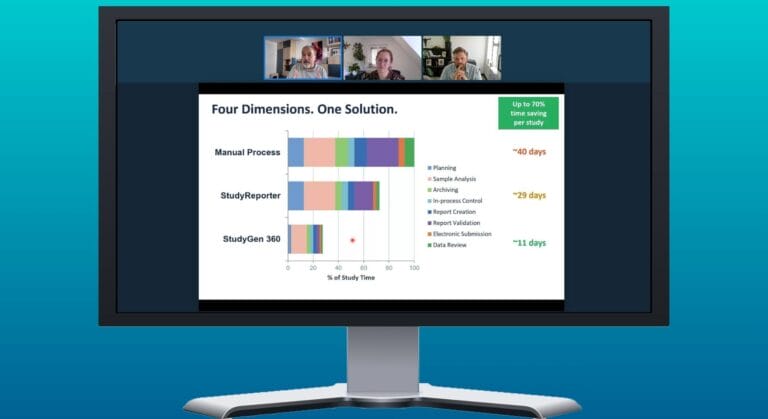
Watch the full discussion to see why an analytical LIMS alone does not secure data integrity in bioanalysis. The conversation follows the complete sample lifecycle — from planning, receipt, and storage to preparation, analysis, and reporting — and shows why the real cost lies in the gaps between systems.
If you have any technical issues watching the video recording, please contact marketing[at]uptodata.com.
The Chain Breaks Before the First Sample Arrives
Long before samples reach the laboratory, the sponsor announces them. Ideally, it includes a pre-shipment manifest with external barcodes, subject IDs, and sample demographics. The laboratory uses this information to plan storage, assign internal barcodes, book instruments, and order reagents. But most analytical LIMS platforms have no native place for this information. They are not designed to manage an expected sample. As the speakers noted, almost every bioanalytical laboratory working with an analytical LIMS maintains an Excel sheet or another workaround for protocol information and shipment manifests.
The real challenge is change. Protocols are amended. Studies are extended. Samples do not arrive. A bioanalytical study may run for one to two years and involve 1,500 samples from 100 subjects, delivered in multiple shipments. Laboratories must know which samples have arrived, which are missing, and whether a barcode has been linked to the wrong sample. This reconciliation must ultimately appear in the final report. When that information is distributed across three or four unsynchronized systems, it must be retyped manually — again and again.
Receipt: Where the Gaps Become Visible
At sample receipt, the gap widens further. A LIMS is built to log samples individually, so a shipment of hundreds of tubes means hundreds of separate entries. The box they arrived in, the shipment they belong to, and the manifest that described them have no natural home in the record. Until every tube has been processed, the delivery as a whole is invisible to the system.
Meanwhile, sample demographics such as subject, timepoint, and collection time stay in a separate spreadsheet. The result is a fragmented record: the sample exists in the LIMS, but the context needed to interpret and defend it lives elsewhere.
Traceability: Freeze-Thaw Cycles, Aliquots, and Deviations
Once a sample is logged, everything must be traceable: arrival time, condition on arrival, box, freezer, room, and every subsequent relocation. Freeze-thaw cycles are one of the clearest examples of why this matters. Assay validation defines how often a sample in its biological matrix may be frozen and thawed. Exceeding the defined limit can invalidate the results. Yet in many laboratories, these cycles are still recorded on a sheet hanging on the freezer or in a spreadsheet that itself would require validation.
Aliquoting adds another layer of complexity. Every aliquot must remain traceable to its original sample and its associated demographics. Deviations make this even more difficult: a hemolyzed sample, a frozen shipment that thawed in transit, a sample left at room temperature for 30 minutes during sorting, or a volume too small for the planned analysis. Document each deviation, report it to the sponsor, and include it in the final report. When an auditor asks what happened to a specific sample, the laboratory must be able to reconstruct its journey from receipt to result. That is where the audit question begins, and the record behind the answer decides how it goes.
From Preparation to Result: How Many Systems Does Your Data Touch?
Sample preparation is a step that no single system covers completely, LIMS platforms included. Workflows differ from assay to assay and from lab to lab, so the documentation lives on paper, in an ELN, or in Excel and Word files. Some details must still be traceable to the final report: reagent lots, calibrator batches, the dilution series, the matrix lot of the QC samples, and who performed the work and when.
Before a run, someone has to define the plate layout and sequence file: which sample sits where, and which calibrators and QCs take which positions. Instrument interfaces can automate this, but they are licensed individually, and smaller laboratories can rarely afford them. So labs typically build the layout in a spreadsheet and transfer it into the instrument software by hand. A single typo in a sample ID turns that transfer into a data integrity failure. The instrument cannot catch it because it has no link to the study record, and the error may surface only during review, when a result matches no planned sample.
Instrument interfaces exist, but smaller laboratories can rarely afford them. Instead, labs create sequence files at the bench and receive results as CSV exports. This is effectively an open interface: anyone with access could open and modify the file, creating a direct data integrity risk. Once results come back, typical bioanalytical questions, such as titer determination or cut-point evaluation across runs, often push teams back into Excel. Teams then assemble the final report in Word. Every copy-and-paste step creates another question that may need answering later and weakens ALCOA+ principles. Counting planning tools and email, the LIMS, the instrument software, the sequence file step, Excel, Word, and document management, the data of a single sample can pass through six or seven systems before the report is signed.
The Real Cost: Customized LIMS vs. Excel and Word
So why not simply close these gaps with a customized LIMS? Customization often requires vendor-specific development, for example, to import each sponsor’s manifest format. That work may take weeks. In a GLP or GxP environment, the subsequent validation — including validation plans, testing, and risk assessments — can take months.
According to Norbert, the larger problem is vendor lock-in. Every upgrade can put existing customizations at risk, preventing laboratories from adopting new features or data structures. In-house development may appear cheaper initially, but when the developer leaves, the knowledge often leaves with them. Small CROs are hit hardest. They work with many sponsors on small projects, each with its own manifests, naming conventions, and study types. Few have the budget to customize and revalidate a LIMS for every sponsor — and every hour spent on IT work is an hour taken away from science.
Staying with Excel and Word does not eliminate the cost; it only shifts it. There may be no LIMS invoice, but there are endless loops of review, QC, and manual reconciliation — plus the risk of findings during an inspection. As the speakers summarized: Excel is simply the modern version of paper. It is digital work, but not digitalization, because the underlying process has not changed.
Thinking From the End: StudyLab and StudyGen 360
StudyGen 360 was designed backward from the end of the process. The team behind it has worked for years in bioanalytical reporting and archiving, so they started with what an audit, a final report, and a long-term archive require and built the platform around those requirements. StudyReporter and StudyArchive Plus handle those final steps. The core concept is the study, not the individual sample. Study-specific questions, such as cut points and titer determination in an immunogenicity study, are part of the data model itself.
StudyLab extends this approach to the laboratory workflow, from sample planning to the final result. CRO labs can adapt instantly to diverse sponsor manifests and study types without relying on developers. Laboratories define their own acceptance criteria, using AI to automatically draft run rules that align with their SOPs. StudyLab captures each step it handles with a complete audit trail, without copy-and-paste. The speakers were also clear about scope. StudyLab does not cover the wet work during sample preparation at the bench, and this documentation remains outside the system. Reporting sits in StudyReporter, so labs that want sample tracking, reporting, and archiving to work together can choose the full StudyGen 360 platform.
Digitalize First, Then Trust Your Data
Can AI close these gaps instead? Not on its own. If demographics live in Excel, storage mapping lives in a LIMS, and results exist only in exported files, AI cannot connect the data consistently. But GxP requires consistency. AI must also understand bioanalytical terminology, where the same term can carry different meanings depending on context. And it needs a validated system behind it. These questions have already been discussed in workshops at the European Bioanalysis Forum (EBF). The speakers’ message is simple: digitalize first, then use AI.
Conclusion: Data Integrity Is a Process Question
The Q&A brought the discussion back to everyday practice. A laboratory that has passed inspections for ten years is not necessarily doing anything wrong. But it should ask what that level of compliance costs in visible and invisible effort. A good SOP for sequence files helps. But it cannot prevent a typo in a sample ID, nor can it detect an edited result file. Norbert recalled an auditor at an EBF meeting who said he opens any sequence or result file he finds in an open directory, writes something into it, and then asks the laboratory how it would detect the change.
No SOP can answer that question. Only a closed system that preserves the data chain from planning to the signed report can.
This recording is part of the up to data Expert Coffee Break series. Featuring Norbert Bittner (CEO & Founder, up to data), Monica Terrao, PhD (Bioanalytical SME), and Magnus Hauman (moderator).
This content might also be engaging for you!
-
The Invisible Compliance Abyss: The Bioanalytical Data Integrity Risk in Every Spreadsheet—and How StudyLab Restores Complete Control
Blog The Invisible Compliance Abyss: The Bioanalytical Data Integrity Risk in Every Spreadsheet—and How StudyLab Restores Complete Control In…
-
Stop the Copy–Paste–Verify–Repeat Loop in GxP Bioanalytical Reporting
Blog Stop the Copy–Paste–Verify–Repeat Loop in GxP Bioanalytical Reporting Every regulated report begins the same way: you gather the…
-
Mitigating the Risks of Non-Digital Study Reporting: What Bioanalytical Labs Need to Know
Blog Mitigating the Risks of Non-Digital Study Reporting: What Bioanalytical Labs Need to Know In a regulated bioanalytical lab,…