Blog
The Interim Decides: Why Clinical Trial Data Cleanliness Cannot Wait for the Final Readout
BMS, argenx, and BioNTech show that the fate of a clinical program is increasingly decided at the interim analysis, not the final readout. For bioanalytical labs and CROs, that means data has to be clean on the day of the cutoff, not weeks later. Here are four practical steps to get from cutoff to a clean snapshot without the fire drill.
Introduction
In modern biopharmaceutical development, major asset decisions rarely wait for the traditional “final” clinical study report. Instead, predefined interim analyses drive shifts in strategy, regulatory filings, and market valuations.
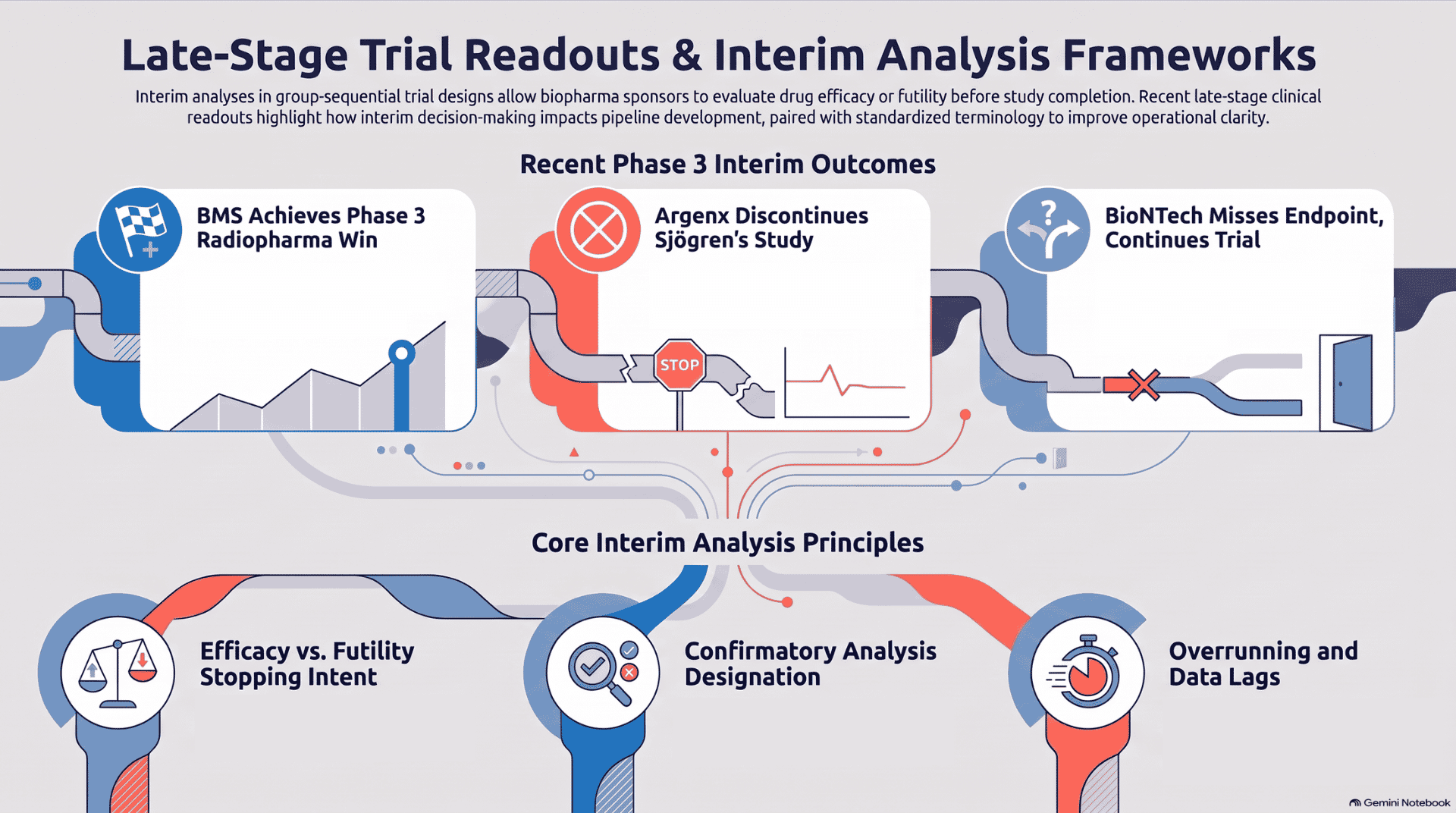
Three recent late-stage clinical readouts highlight how pivotal these interim checkpoints are across oncology and immunology:
BioNTech reported that its experimental mRNA cancer immunotherapy BNT113 combined with Keytruda did not extend progression-free survival compared to Keytruda monotherapy at an interim data check in first-line HPV16-positive head and neck squamous cell carcinoma. Following recommendations from the Data Monitoring Committee, the trial remains ongoing to evaluate the co-primary endpoint of overall survival (OS), and the company’s shares declined about 6% after the disclosure.
Bristol Myers Squibb (BMS) achieved a major milestone in its Phase 3 ACTION-1 trial evaluating RYZ101 (actinium-225) in somatostatin receptor–expressing gastroenteropancreatic neuroendocrine tumors (GEP-NETs). A planned interim analysis met its primary endpoint, demonstrating a statistically significant and clinically meaningful improvement in progression-free survival (PFS) by blinded independent central review after reaching a target threshold of 143 PFS events. Marking the first Phase 3 results for an alpha-isotope targeted radiopharmaceutical therapy in any indication, BMS is preparing for regulatory engagement with the FDA.
argenx discontinued its Phase 3 UNITY study evaluating Vyvgart Hytrulo (efgartigimod subcutaneous) in moderate-to-severe Sjögren’s disease. An Independent Data Monitoring Committee (IDMC) interim analysis concluded the trial was unlikely to meet its primary endpoint (clinESSDAI at Week 48) and recommended stopping for futility, leading to a double-digit stock decline.
Whether a trial delivers a landmark efficacy win, hits a PFS miss, or faces a futility stop, the fundamental operational reality is the same: the fate of a clinical asset is sealed on the day of the interim cutoff.
Infographic 1: Recent Phase 3 Interim Outcomes and Analysis Principles
The Operational Strain: CCOD vs. Snapshot Date
A core challenge in clinical operations systems stems from the event-driven nature of interim analyses. Because trial sponsors cannot control the exact date event triggers are met, cutoff dates fall within tight operational windows.
Methodological standards in group-sequential designs distinguish clearly between two key operational milestones:
- Clinical Cutoff Date (CCOD): The predetermined date on or before which all clinical events, samples, and patient data are recorded for analysis.
- Snapshot Date (SSD): The date when the database is extracted and fully cleaned for analysis following site data entry, query resolution, and data reconciliation.
Methodological standards highlight the operational gap between the CCOD and the SSD (when the cleaned database is extracted). While a futility snapshot can often be pulled within 4 weeks, cleaning data following an efficacy stop typically requires up to 7 weeks. Because an efficacy win triggers rapid regulatory filings with health authorities, every bioanalytical result, sample tracking log, and re-analysis record must be fit for purpose, traceable, and fully reconciled immediately.
Typical Bottlenecks in the Lab
Without integrated informatics, lab teams frequently encounter predictable friction points during interim data locks:
- Manual Sample Reconciliation: Mismatches between central lab biobank inventories and clinical site sample logs.
- Excel-Based Handoffs: Error-prone manual data transfers between LIMS, CRO spreadsheets, and sponsor EDC systems.
- Unresolved Queries & Re-assays: Open bioanalytical queries or pending repeat analyses lingering close to the CCOD.
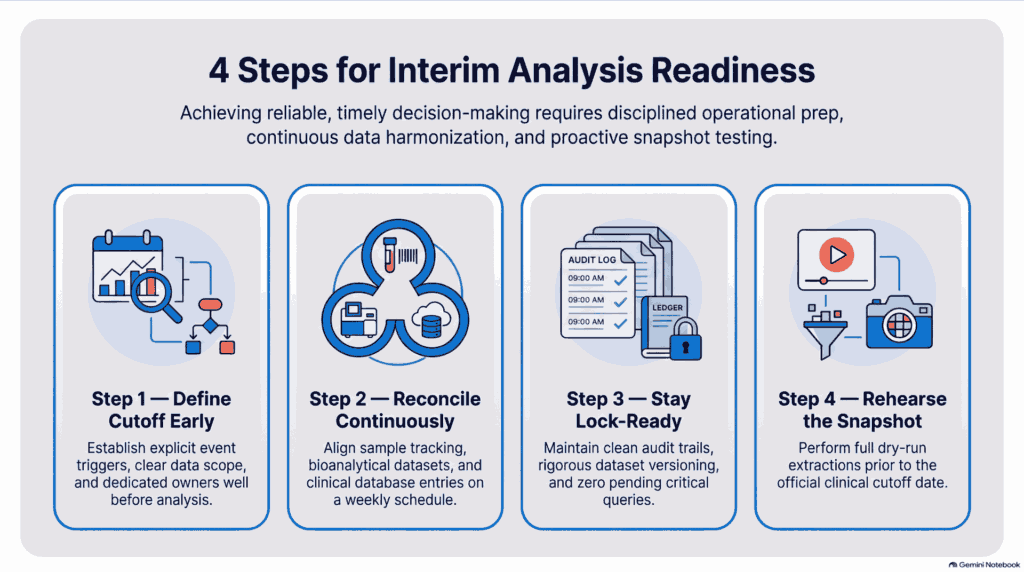
4 Steps to Interim Readiness: A Checklist for Labs & CROs
To move from reactive fire drills to routine data locks, bioanalytical labs and CROs should evaluate their operational readiness using four core questions:
- Define the Cutoff Early: Establish exact data scopes, event triggers, governance rules, and data ownership before the first patient is randomized.
- Reconcile Continuously: Perform weekly automated cross-reconciliation between central laboratories, bioanalytical assays, sample biobanks, and clinical EDC databases rather than waiting for CCOD.
- Stay Lock-Ready: Maintain real-time control over open queries, protocol deviations, audit trails, and dataset versions to keep the database submission-ready at all times.
- Rehearse the Snapshot: Conduct a mock interim analysis (“dry run”) prior to the estimated CCOD to test data extraction pipelines and cross-functional team responsiveness.
Infographic 2: Define, Reconcile, Stay, and Rehearse in Interim Analysis
Conclusion: Streamlining Bioanalytical Data Locks – Making the Interim a Routine
The three readouts at the start of this article ended very differently: an efficacy win, a missed endpoint, and a futility stop. Yet each was decided at a predefined cutoff, on a date no one could fully control. For bioanalytical labs and CROs, that is the operational reality to plan for. The interim will not wait for your data lock.
The four steps above share one root problem. Most delays between cutoff and snapshot are not caused by missing data. They are caused by data that exists but lives in separate places: sample logs in one system, assay results in another, reconciliation in spreadsheets, and decisions in email threads. Every handoff between these places is a potential mismatch that someone has to find, explain, and fix under time pressure. Eliminating data lock bottlenecks requires breaking down the barriers between laboratory execution and clinical data management.
This is where StudyGen 360 comes in. It brings study management, sample tracking, and bioanalytical laboratory workflows together in a single environment, which supports each step directly:
- Define the cutoff early: Set study scope, sample schedules, and responsibilities in the same place where the data will later be generated.
- Reconcile continuously: Link samples, results, and study records from the start, so mismatches surface when they happen, not weeks later.
- Stay lock-ready: Document audit trails, result versions, and re-analysis decisions as part of the workflow, not reconstructed at the end.
- Rehearse the snapshot: When the data is already connected, a dry run becomes a quick check instead of a project in itself.
The goal is simple: when the cutoff hits, your data should already be clean, traceable, and ready to hand over. Then the interim becomes routine, and your team can focus on what the result means rather than gathering the data..
Bibliography
Alvarado, D. (2026). BioNTech mRNA cancer immunotherapy misses first objective in key study. BioPharma Dive. https://www.biopharmadive.com/news/biontech-mrna-immunotherapy-hpv16-head-neck-cancer/832854/.
Asikanius, E., Hofner, B., Hampson, L. V., Wassmer, G., Jennison, C., Mielke, T., Kunz, C. U., & Rufibach, K. (2025). Clinical trials with interim analyses: Standardizing terminology to increase clarity (arXiv:2410.01478). arXiv. https://arxiv.org/pdf/2410.01478.
Masson, G. (2026). BMS’ $4.1B RayzeBio bet delivers Phase 3 radiopharma win. BioSpace. https://www.biospace.com/drug-development/bms-4-1b-rayzebio-bet-delivers-phase-3-radiopharma-win.
Turner, D. (2026). Argenx discontinues Phase III Sjögren’s disease trial. Drug Discovery World (DDW). https://www.ddw-online.com/argenx-discontinues-phase-iii-sjogrens-disease-trial-44256-202610/.
up to data has been supporting pharmaceutical and life sciences companies with automated laboratory processes for regulatory study data management for over 20 years. Our solutions eliminate data silos, implement secure automated data transfer processes, and reduce manual activities while ensuring full regulatory compliance.
This content might also be engaging for you!
-
The Invisible Compliance Abyss: The Bioanalytical Data Integrity Risk in Every Spreadsheet—and How StudyLab Restores Complete Control
Blog The Invisible Compliance Abyss: The Bioanalytical Data Integrity Risk in Every Spreadsheet—and How StudyLab Restores Complete Control In…
-
Stop the Copy–Paste–Verify–Repeat Loop in GxP Bioanalytical Reporting
Blog Stop the Copy–Paste–Verify–Repeat Loop in GxP Bioanalytical Reporting Every regulated report begins the same way: you gather the…
-
Mitigating the Risks of Non-Digital Study Reporting: What Bioanalytical Labs Need to Know
Blog Mitigating the Risks of Non-Digital Study Reporting: What Bioanalytical Labs Need to Know In a regulated bioanalytical lab,…