Blog
The Invisible Compliance Abyss: The Bioanalytical Data Integrity Risk in Every Spreadsheet—and How StudyLab Restores Complete Control
In an era of harmonized global standards like ICH M10, using standalone spreadsheets to manage bioanalytical study data poses a critical risk to drug approvals and laboratory survival. Real-world regulatory suspensions show that manual workflows often can no longer withstand rigorous GxP data integrity audits. Learn how switching from manual tracking to StudyLab implementation creates an impenetrable, submission-ready data lifecycle from sample receipt to final reporting.

Introduction
In modern drug development, the reliability and integrity of bioanalytical data ultimately determine a drug candidate’s success. The regulatory landscape has never been more challenging for small bioanalytical laboratories and contract research organizations (CROs). The global implementation of the ICH M10 guideline has harmonized bioanalytical method validation and study sample analysis, setting an exceptionally high bar for scientific and compliance standards.
Meanwhile, regulatory bodies such as the U.S. Food and Drug Administration (FDA) and the U.K. Medicines and Healthcare Products Regulatory Agency (MHRA) are cracking down on Good Laboratory Practice (GLP) and Good Manufacturing Practice (GMP) data integrity infractions. In this environment, relying on manual data management, standalone spreadsheets, or hybrid paper-electronic setups is not just an administrative headache; it is a critical risk to your business’s survival.
Laboratories seeking to bridge the gap between initial analysis and final reporting must understand the absolute necessity of GxP-compliant automated lab integration. This article examines the strict compliance requirements in modern bioanalysis and the data integrity issues associated with paper-based systems. It also explains how a unified scientific data platform like StudyGen 360 with its Applications StudyLab and StudyReporter secures your data lifecycle from pipetting to final submission.
The Hard Science and High Stakes of ICH M10 and GxP
The ICH M10 guideline governs the validation of bioanalytical methods and the analysis of study samples for chemical and biological drugs in regulatory submissions. The guideline covers nonclinical toxicokinetic (TK) studies conducted under Good Laboratory Practice (GLP), nonclinical pharmacokinetic (PK) studies that act as surrogates for clinical studies, and all phases of clinical trials, including pivotal comparative bioavailability/bioequivalence (BA/BE) studies.
The guideline distinguishes between chromatographic assays (e.g., LC-MS) and ligand-binding assays (LBAs) and imposes exhaustive requirements on both.
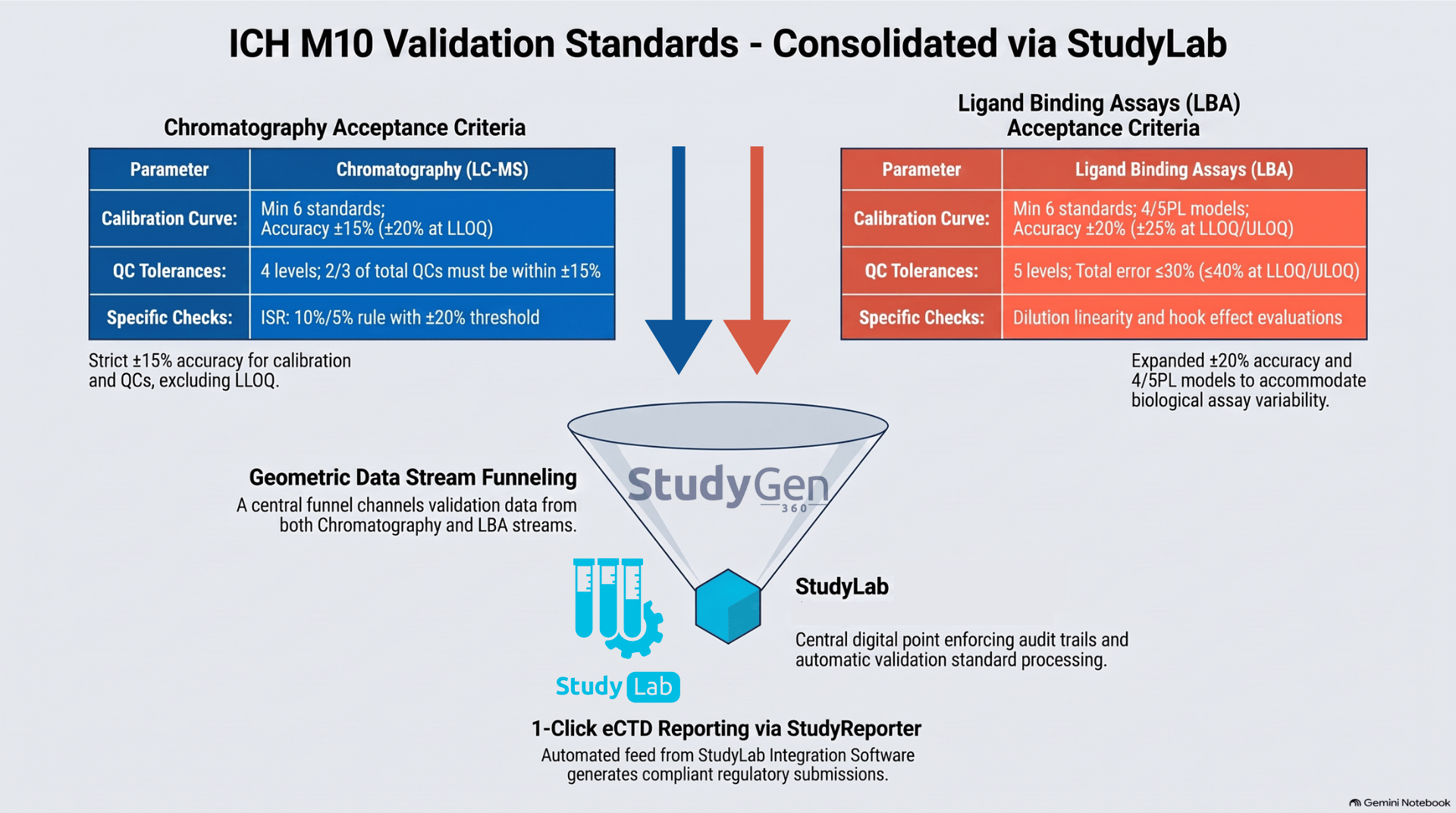
ICH M10 at a Glance: Chromatographic Assays vs. Ligand-binding Assays (LBAs)
| Chromatographic (LC-MS/MS, GC) | Ligand-binding Assays (LBAs) | |
|---|---|---|
| Validation Parameters | Selectivity, specificity, matrix effect, calibration curve, range, accuracy, precision, carry-over, dilution integrity, stability, reinjection reproducibility | Specificity, selectivity, calibration curve, range, accuracy, precision, carry-over, dilution linearity, stability |
| Selectivity Sources | ≥ 6 blank matrix lots | ≥ 10 blank matrix lots; blank response below LLOQ in ≥ 80% of sources |
| Interference Limit | ≤ 20% of analyte LLOQ response; ≤ 5% of IS response | Accuracy within ±25% at LLOQ, ±20% at HQC, in ≥ 80% of sources |
| Calibration Curve | Blank + zero sample + ≥ 6 concentration levels (LLOQ to ULOQ) | Blank + ≥ 6 concentration levels (LLOQ to ULOQ) |
| Accuracy and Precision | Within ±15% (±20% at LLOQ); ≥ 5 replicates per QC level per run, ≥ 3 runs over ≥ 2 days | Within ±20% (±25% at LLOQ and ULOQ); ≥ 6 independent runs |
| Total Error | Not applicable | ≤ 30% (≤ 40% at LLOQ and ULOQ) |
| QC Acceptance in Study Runs | ≥ 2/3 of all QCs and ≥ 50% per level within ±15% | ≥ 2/3 of all QCs and ≥ 50% per level within ±20% |
| Freeze-thaw Stability | ≥ 3 cycles, ≥ 12 h frozen between thaws | ≥ 3 cycles, ≥ 12 h frozen between thaws |
Incurred sample reanalysis is mandatory for pivotal comparative BA/BE studies, the first clinical trial in subjects, pivotal early patient trials, and trials in patients with hepatic or renal impairment. Reanalyze 10% of the first 1,000 samples plus 5% of anything beyond that, on separate days, with samples selected around C_max and in the elimination phase. At least 2/3 of repeats must fall within ±20% (chromatographic) or ±30% (LBA) of the mean.
Infographic 1: ICH M10 Run Acceptance & Validation Criteria
The Critical Trap of “Static” vs. “Dynamic” Records
Many small laboratories mistakenly believe that keeping printed chromatograms, paper run sheets, or static PDF files satisfies regulatory requirements for raw data. However, FDA and MHRA guidance has completely dismantled this misconception.
Regulations clearly distinguish between static and dynamic records.
- Static records: Fixed-data formats, such as paper printouts or flat electronic images (PDFs), that allow little to no interaction with the record content. Once printed or converted, chromatography records lose the ability to be reprocessed or to allow more detailed baseline viewing.
- Dynamic Records: Interactive formats that allow users to analyze the data. Electronic records in database formats, for example, allow users to track, trend, and query data. Electronically maintained chromatography records allow reviewers to reprocess data and expand the baseline to view the integration more clearly.
The MHRA explicitly states that information originally captured in a state enabling dynamic interaction must remain available in that state. Furthermore, paper printouts do not preserve metadata, which is the structured context that gives data meaning. This includes time/date stamps, instrument IDs, and the exact user ID of the analyst performing the analysis. Without metadata, a number like “3.5 mg” is scientifically meaningless. With metadata, however, it becomes “Trial Subject A123, Sample Ref. X789, Taken 06/30/14 at 14:56, Weighed 3.5 mg by Analyst J. Smith on 07/01/14.”
According to FDA 21 CFR Part 11 and GxP data integrity rules, maintaining only a static record of dynamic data is noncompliant because it does not allow complete reconstruction of analytical activities. Simple balances or pH meters can rely on static printouts as the original raw data, since they do not store data electronically. However, complex instrument systems, such as FT-IR or HPLC, generate dynamic spectral and chromatographic files that must be retained electronically.
Reintegration and Reanalysis: The Audit Trail Battlefield
During regulatory inspections, two bioanalytical procedures receive immediate, hyper-focused attention: chromatogram reintegration and study sample reanalysis.
Chromatogram Reintegration
The ICH M10 guideline requires that procedures for integrating and reintegrating chromatograms be defined in advance in a study plan or SOP. If any peak requires manual integration or reintegration, document the reason explicitly. Preserve both the original and reintegrated chromatograms, along with the initial and repeat results.
Without a secure, computer-generated, time-stamped audit trail, you cannot demonstrate GxP compliance during peak processing. An audit trail must track “who, what, when, and why.” It must capture the creation, modification, or deletion of data, including processing parameters and results. If your chromatography data system allows analysts to modify integration parameters without capturing the change, timestamp, and justification in a locked audit trail, the study is legally compromised.
Study Sample Reanalysis
ICH M10 places strict boundaries on repeat analyses. Reanalysis of study samples for pharmacokinetic (PK) reasons (e.g., a sample concentration that does not fit the expected profile) is strictly unacceptable for comparative bioavailability/bioequivalence (BA/BE) studies, as it introduces systematic bias. Reanalysis of samples is permitted only for verified technical reasons, such as equipment failure, calibration standard failure, quality control (QC) failure, a concentration that exceeds the upper limit of quantitation (ULOQ), or improper sample injection. Each repeat run must document the original value, the technical reason for the repeat, the repeat values obtained, and a clear justification for the reported value.
Manually tracking these records on paper sheets or Excel files makes it nearly impossible to prove to an inspector that no unauthorized “testing into compliance” or undocumented PK repeats occurred.
When Data Management Fails: Two Regulatory Case Studies
Inadequate data management has ended studies, not just delayed them. Two recent cases show what regulatory inspectors look for — and what they do when the records don’t hold up.
Consider the case of Panexcell Clinical Laboratories (2020)
In July 2020, the European Medicines Agency (EMA) recommended suspending the marketing authorizations for generic drugs tested by Panexcell Clinical Laboratories in Mumbai. GCP inspections conducted by German and Austrian authorities revealed systemic quality failures.
Inspectors found sample concentrations from different patients to be exceptionally similar, suggesting either data manipulation or a complete failure to track samples.
Personnel were caught documenting incorrect room temperatures for areas where biological samples were processed.
Because bioanalytical sample stability depends heavily on temperature, manually logging incorrect environmental data undermined the scientific integrity of the studies.
The Synapse Labs Case (2024)
In March 2024, the EMA confirmed its recommendation to suspend or revoke hundreds of generic drug authorizations that were tested by Synapse Labs Pvt. Ltd., a contract research organization (CRO) based in Pune. The GCP inspection revealed:
- widespread irregularities in study data
- severe inadequacies in study documentation
The inspection also found fundamental deficiencies in the computer systems and procedures used to manage study data.
Consequently, the U.S. FDA declared the bioanalytical studies conducted by Synapse Labs (June 2024) and Panexcell (September 2021) unacceptable for use in supporting regulatory decisions. Regulators will not tolerate inadequate computer systems, standalone spreadsheets, or insecure data pipelines.
The Journey of a Bioanalytical Sample: Excel vs. StudyLab
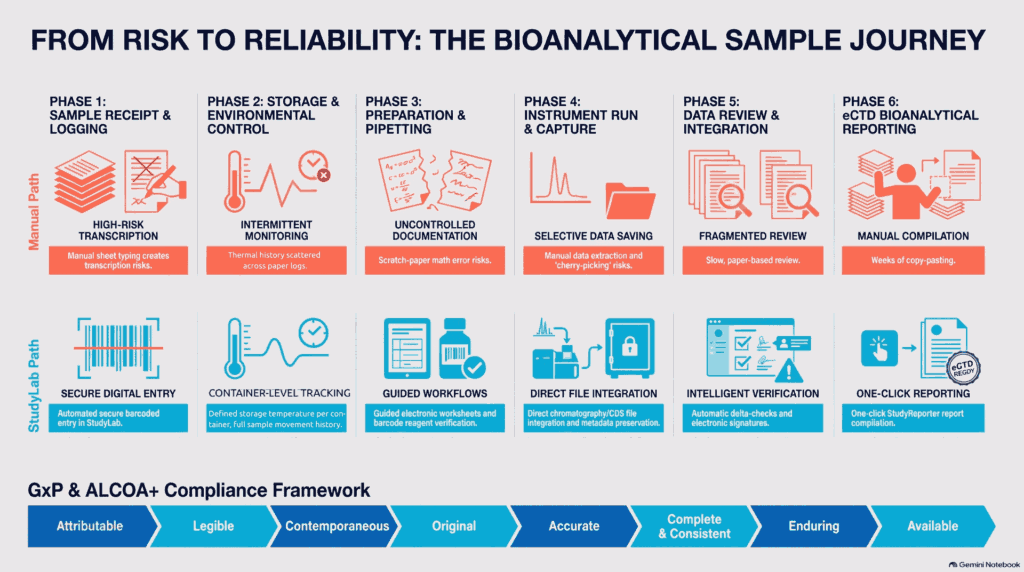
Many small CROs use unvalidated Microsoft Excel spreadsheets to manage their daily workflows. Although Excel appears flexible, it poses compliance risks at every stage of the sample lifecycle. The table below contrasts the high-risk manual workflow with the secure digital workflow of StudyLab and StudyReporter.
| Lifecycle Stage | High-Risk Manual Excel Path | Compliant StudyLab and StudyReporter Integration Path |
|---|---|---|
| Sample Receipt & Logging | This involves manually logging tube counts and patient IDs on paper sheets. Transcription errors are common (e.g., typing “109” as “1009”). | Barcoded login. Staff scan sample shipments, and StudyLab automatically populates records with exact timestamps, shipper IDs, and system-validated inventory. |
| Storage & Environmental Control | Staff manually record temperature logs once a day. This makes them susceptible to falsified entries or missed freeze-thaw events, which can lead to a “Panexcell-style” inspection failure. | Every sample sits in a container with a defined storage temperature, and each move to a differently tempered container is recorded — a documented thermal chain of custody per aliquot, without manual freezer logs. |
| Preparation & Pipetting | Handwritten master worksheets are vulnerable to math errors. Analysts manually calculate dilution factors and pipette settings on scratch paper, a process that is prone to math errors. | Structured electronic worksheets include automated calculations. Barcode scanners verify reagents, reference standard lots, and pipettes before use. |
| Instrument Run & Capture | Analysts manually export raw peak areas from chromatographic software into Excel. There is a high risk of data cherry-picking or “testing into compliance” when failed injections are omitted. | The direct instrument integration automatically transforms raw chromatography and LBA plate reader files into dynamic, searchable records while preserving all original metadata and file structures. |
| Data Review & Integration | A second-person review manually cross-references printed chromatograms with Excel cells, an extremely slow and error-prone process. | GxP-compliant electronic signatures are included. Reviewers are instantly flagged for manual reintegration events and have direct access to the dynamic audit trail. |
| eCTD Bioanalytical Reporting | Copy and paste regression parameters, QC tables, and validation statistics into Word documents. Compiling a final report takes weeks. | Generate fully compliant bioanalytical reports automatically in accordance with Table 1 of the ICH M10 guideline. Compile QC graphs, run histories, and reintegration tables immediately. |
Infographic 2: Sample Journey in StudyLab vs Manual Excel
Conclusion
In today’s regulatory landscape, operating a bioanalytical laboratory without a GxP-compliant software integration platform is an unsustainable risk. International standards such as ICH M10 now enforce stringent validation and data lifecycle requirements, so manual and paper-based data management cannot withstand modern regulatory audits.
StudyLab and StudyReporter provide especially smaller laboratories and CROs with the robust, validated infrastructure needed to ensure compliance, transforming data management from a regulatory burden into a competitive advantage.
Bibliography
European Medicines Agency (EMA) (2024). Synapse Labs Pvt. Ltd: re-examination confirms suspension of medicines over flawed studies. URL: https://www.ema.europa.eu/en/medicines/human/referrals/synapse.
European Medicines Agency (EMA) (2020). Panexcell Clinical Laboratories: suspension of medicines over flawed studies, Article-31 Referral. URL: https://www.ema.europa.eu/en/medicines/human/referrals/panexcell.
International Council for Harmonization (ICH) (2022). ICH Consensus Guideline: Bioanalytical Method Validation and Study Sample Analysis M10. URL: https://database.ich.org/sites/default/files/M10_Guideline_Step4_2022_0524.pdf.
Medicines & Healthcare products Regulatory Agency (MHRA) (2018). ‘GxP’ Data Integrity Guidance and Definitions. URL: https://assets.publishing.service.gov.uk/media/5aa2b9ede5274a3e391e37f3/MHRA_GxP_data_integrity_guide_March_edited_Final.pdf.
U.S. Food and Drug Administration (FDA) (2018). Data Integrity and Compliance With Drug CGMP: Questions and Answers Guidance for Industry. URL: https://www.fda.gov/media/119267/download.
U.S. Food and Drug Administration (FDA) (2026). Notifications on Data Integrity – List of Unacceptable Studies (including Panexcell & Synapse). URL: https://www.fda.gov/drugs/drug-safety-and-availability/notifications-data-integrity.
up to data has been supporting pharmaceutical and life sciences companies with automated laboratory processes for regulatory study data management for over 20 years. Our solutions eliminate data silos, implement secure automated data transfer processes, and reduce manual activities while ensuring full regulatory compliance.
This content might also be engaging for you!
-
Stop the Copy–Paste–Verify–Repeat Loop in GxP Bioanalytical Reporting
Blog Stop the Copy–Paste–Verify–Repeat Loop in GxP Bioanalytical Reporting Every regulated report begins the same way: you gather the…
-
Mitigating the Risks of Non-Digital Study Reporting: What Bioanalytical Labs Need to Know
Blog Mitigating the Risks of Non-Digital Study Reporting: What Bioanalytical Labs Need to Know In a regulated bioanalytical lab,…
-
Long-term Study Archiving After Watson LIMS™: Key Insights for Regulated Bioanalytical Labs
Blog Long-term Study Archiving After Watson LIMS™: Key Insights for Regulated Bioanalytical Labs In a regulated bioanalytical lab, the…